Introduction
Over the past decade, the death penalty in Saudi Arabia has followed an escalating and increasingly brutal trajectory, revealing the reality of state practices long concealed behind reformist rhetoric, official assurances, and carefully curated narratives of openness. In 2025, this reality once again manifested with devastating clarity, as executions claimed the lives of juveniles in flagrant defiance of international legal standards, public appeals, diplomatic interventions, and the Kingdom’s own declared commitments to human rights protection.
These practices demonstrate a sustained disregard for Saudi Arabia’s international obligations and for the fundamental right to life. Image-polishing campaigns and narratives of reform have provided no protection from the executioner’s blade—not even for those who spent years on death row, trapped between official promises and deliberate delays, awaiting justice that never materialised.
Since 2015, the use of the death penalty has increasingly reflected the political direction of the Saudi state. Official discourse centred on “unprecedented reforms” has coincided with a steady expansion in the scope and application of capital punishment. From mass executions, to the introduction of new offences punishable by death, to the systematic targeting of the most vulnerable groups—who now constitute the majority of those executed—this policy has become unmistakably clear. In 2025, as Saudi Arabia shattered its execution record for the second consecutive year, resumed the execution of juveniles, executed a journalist, and manipulated the fate of detainees through cycles of delay and reprieve, the death penalty emerged as an exposed and undeniable emblem of state practice.
Through this annual report, the European Saudi Organization for Human Rights (ESOHR) provides a comprehensive analysis of execution figures in 2025, documents the cases behind the numbers, and sheds light on the grave violations that accompanied arrest, trial, and execution, as part of its ongoing efforts to expose the reality of capital punishment in Saudi Arabia.
The Numbers
Five women were executed in 2025. These cases included one conviction related to kidnapping and sorcery, two Saudi women convicted of murder, and two women executed for drug-related offences—one Nigerian and one Afghan national. Saudi Arabia resumed executions of women for drug offences in 2019 following the execution of a Nigerian woman. Although public information on these cases remains limited, credible indicators raise serious concerns that some of these women may have been victims of human trafficking.
Five women were executed in 2025. These cases included one conviction related to kidnapping and sorcery, two Saudi women convicted of murder, and two women executed for drug-related offences—one Nigerian and one Afghan national. Saudi Arabia resumed executions of women for drug offences in 2019 following the execution of a Nigerian woman. Although public information on these cases remains limited, credible indicators raise serious concerns that some of these women may have been victims of human trafficking.
Five women were executed in 2025. These cases included one conviction related to kidnapping and sorcery, two Saudi women convicted of murder, and two women executed for drug-related offences—one Nigerian and one Afghan national. Saudi Arabia resumed executions of women for drug offences in 2019 following the execution of a Nigerian woman. Although public information on these cases remains limited, credible indicators raise serious concerns that some of these women may have been victims of human trafficking.
Available data indicate that the majority of executions were carried out in drug-related cases, totalling 240 executions, in clear violation of the principle under international law that restricts the death penalty to the “most serious crimes,” defined as intentional killing. Political executions accounted for 45 cases, 75% of which did not involve any charge of murder, according to Ministry of Interior statements. By contrast, 60 executions were carried out in murder cases, alongside a smaller number of cases involving armed robbery, kidnapping, sorcery, and alleged gang formation.
Juveniles
In 2025, Saudi Arabia resumed the execution of juveniles, in blatant violation of its previous official commitments, including the Juvenile Law and a royal decree that authorities had claimed halted discretionary death sentences for individuals who were under 18 at the time of the alleged offence. Prior to this, the execution of juvenile Mustafa al-Darwish in June 2021 was the last such case documented by ESOHR.
These executions were accompanied by severe violations, including the failure to notify families in advance of execution dates, the denial of the right to a final farewell, and the refusal to return bodies or disclose burial locations. In several cases, families learned of the executions only through unofficial sources.
The executions were carried out despite explicit legal opinions issued by UN experts, including the Working Group on Arbitrary Detention, which confirmed that the detention of these juveniles was arbitrary and that their continued detention and sentencing constituted an unlawful deprivation of the right to life.
On 21 August 2025, Saudi Arabia announced the execution of juvenile Jalal Labad following a trial that failed to meet the most basic standards of fairness and relied on confessions extracted under torture, in clear violation of the Convention against Torture. While the Ministry of Interior claimed that Labad faced a murder charge, ESOHR’s documentation, based on court records, confirms that he was not charged with direct murder. Labad was arrested on 23 February 2017 during a raid on his home in al-Awamiya without an arrest warrant. He was subjected to nearly nine and a half months of solitary confinement, denied access to legal counsel, and tortured repeatedly. He was not brought before the Specialized Criminal Court until more than two years after his arrest. Charges against him included participation in demonstrations at the age of 15, attending funerals, and allegedly sheltering “wanted persons.”
On 20 October 2025, Saudi Arabia executed juvenile Abdullah al-Darazi. He was arrested at the age of 18 for charges related to acts committed during childhood that did not constitute “most serious crimes.” He was held in solitary confinement for six months, subjected to physical and psychological torture to extract confessions, and forcibly disappeared during the first three months of his detention. Despite informing the court that his confessions had been obtained under torture and in the absence of legal assistance, the court issued a discretionary death sentence without presenting any material evidence.
Drug-Related Executions
Drug-related executions more than doubled in 2025 compared to 2024, which recorded 122 such cases. During 2025, the Saudi Press Agency published 222 execution announcements related to drug offences, including 100 cases involving cannabis trafficking, receipt, or distribution—a charge for which death sentences began to be implemented only in the previous year. Thirty-nine of these cases involved Somali nationals, all detained in Najran Prison.
Non-Saudis accounted for 81% of all drug-related executions. Saudi Arabia resumed executions for drug offences in May 2024 after a nine-month suspension, following a pattern of repeated pauses, including one that lasted nearly two years between January 2020 and November 2021. These cycles of suspension and resumption have constituted a form of severe psychological torture for prisoners and their families.
Since 2024, ESOHR has monitored the cases of 34 Egyptian nationals facing execution in Tabuk Prison and documented a consistent pattern of grave violations. On 18 February 2025, several detainees began a hunger strike to protest restrictions on communication with their families, severely limited phone access, and degrading treatment during transfers to the prison clinic, including being forced to walk barefoot while shackled. As a result, some detainees refrained from seeking medical care despite serious illnesses.
On 14 April 2025, following the suspension during Ramadan and Eid, authorities resumed executions by executing a Sudanese detainee who was reportedly woken from sleep and taken directly to the execution site. Subsequently, executions in Tabuk were halted for 50 days between June and August, creating false hope among families that sentences would be commuted. In July, families were informed that cases were under review by order of the Crown Prince, and a representative of the Saudi Human Rights Commission visited the prison. Families were later pressured not to raise the cases publicly or with human rights mechanisms.
On 15 September 2025, Saudi Arabia executed four Egyptian nationals despite the submission of legal petitions for reconsideration, which should have legally suspended executions pending adjudication. On 16 December 2025, Egyptian national Essam al-Shazly was executed in Tabuk Prison while his family awaited a Supreme Court decision on a submitted appeal. The family later learned that the appeal had been rejected only one day prior to the execution. By the end of 2025, Saudi Arabia had executed 24 Egyptian nationals, while ten others remained on death row in Tabuk Prison.
In all documented cases, families were not notified in advance of execution dates, were denied the right to a final farewell, and were refused the return of bodies for burial.
Freedom of Expression Cases
On 14 June 2025, the Saudi Ministry of Interior announced the execution of journalist Turki al-Jasser, who was accused of “treason”—a vague and expansive charge increasingly used in recent years. His execution marks the first documented execution of a journalist in Saudi Arabia and raises grave concerns for the fate of dozens of forcibly disappeared individuals and detainees held in prolonged solitary confinement, including writers and journalists.
Al-Jasser was arrested on 15 March 2018 during a raid on his home in Riyadh by plainclothes intelligence officers, who confiscated his electronic devices and personal belongings before taking him to an undisclosed location. He was reportedly detained after authorities discovered his management of an anonymous Twitter (X) account linked to the “Kashkool” website, which published commentary on arrests and criticism of government economic and social policies. From the moment of his arrest, al-Jasser was forcibly disappeared and largely denied contact with his family and the outside world, leading to persistent reports that he had died under torture during detention.
إضافة إلى ذلك، نفذت السعودية 44 إعداما بناء على أحكام صادرة عن المحكمة الجزائية المتخصصة سيئة الصيت، والتي تستخدم بشكل واسع لتجريم ممارسات سلمية مثل التعبير عن الرأي والتظاهر. بحسب بيانات وزارة الداخلية فإن معظم القضايا لم يواجه فيها المعتقلون تهمة القتل استنادا إلى بيانات وزارة الداخلية، حيث أن 34 قضية واجه فيها المعتقلون تهم: تمويل، وتستر خيانة عظمى والانضمام إلى تنظيم إرهابي، وهي تهم فضفافضة. من بين الذين أعدموا بتهم سياسية لم ترصد المنظمة إلا سبع قضايا قبل التنفيذ.
Disregard for International Mechanisms
Saudi Arabia continued to ignore legal opinions and public appeals issued by UN experts. On 30 April 2025, the Working Group on Arbitrary Detention issued a statement expressing concern over the continued prosecution of five juveniles for acts committed during childhood, such as participating in protests or attending funerals. The Group confirmed that any execution of these individuals would constitute an arbitrary and unlawful execution in violation of Saudi Arabia’s international obligations.
Despite this, on 21 August 2025, Saudi Arabia executed Jalal Labad in complete disregard of private communications, public statements, and legal opinions. On 5 September 2025, UN experts expressed shock at Labad’s execution and demanded the immediate return of his body to his family and the conduct of an independent forensic examination.
UN experts reiterated that the execution of individuals convicted for acts allegedly committed while under 18 is prohibited under international law and constitutes an arbitrary deprivation of life.
On 10 June 2025, Special Rapporteur Morris Tidball-Binz called for a halt to the imminent execution of 26 Egyptian nationals in drug-related cases, noting that two had already been executed without notification to their families.
In April 2025, the Saudi government refused a request by the Independent Expert on the enjoyment of all human rights by older persons, Claudia Mahler, to meet with cleric Salman al-Awda, whose execution has been sought since 2017. Authorities cited insufficient time, despite the request having been submitted 24 hours in advance. The Expert stated that this refusal violated the terms of country visits, including the right to conduct unmonitored communications with detainees, and undermined her ability to document violations.
Current Situation
Execution data indicate that 2025 witnessed what appears to be a systematic and accelerated execution of death row prisoners in drug-related cases, particularly in Najran and Tabuk prisons. According to reliable information, the number of Somali prisoners on death row declined from approximately 50 to 20, while the number of Ethiopian prisoners dropped from 48 to 18, amid successive executions and a lack of official transparency regarding detainees’ fate. Although no official figures exist, it is likely that hundreds of detainees remain at risk of execution. This reflects a dangerous pattern of systematically emptying prisons through executions and raises serious concerns about continued execution waves carried out without independent oversight or legal safeguards.
In political and expression-related cases, ESOHR confirms that more than 58 detainees currently face death sentences at various stages of litigation for activities related to protest and freedom of expression.
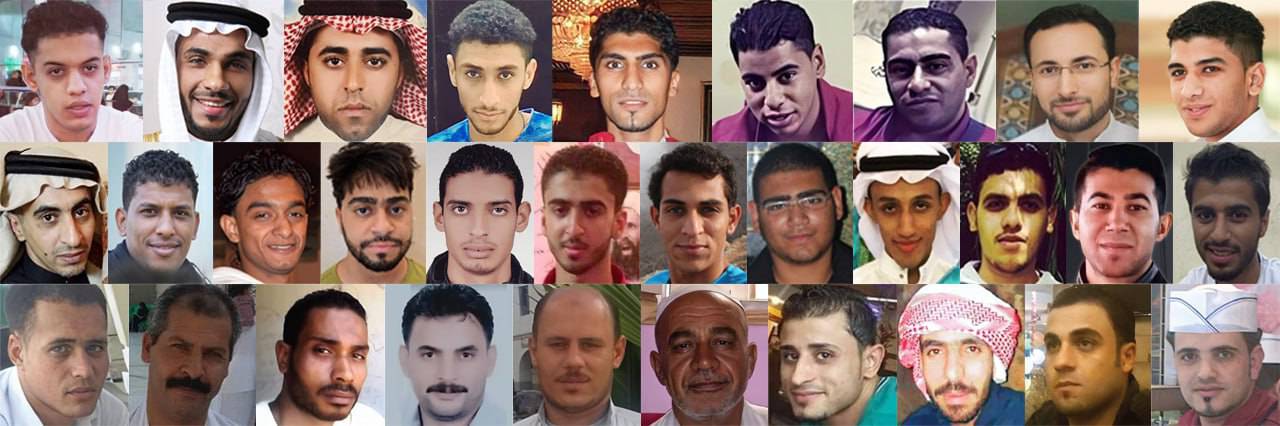
Among those currently facing execution are six juveniles: Yousef al-Manasif, Ali al-Mubayyouq, Hassan Zaki al-Faraj, Ali Hassan al-Sbeiti, Jawad Qureiris, and Mahdi al-Muhsin. The Working Group on Arbitrary Detention has confirmed that their detention is arbitrary and that their death sentences are invalid, calling for their release.
Dozens of others face execution despite grave violations in their cases, including torture, ill-treatment, and denial of the right to defence. Some were promised commutations or retrials, yet the Specialized Criminal Court reissued death sentences without investigating allegations of torture or evidentiary flaws. These include Mohammed al-Faraj, Mohammed Labad, and Saud al-Faraj, whose detention was also deemed arbitrary by the Working Group.
Additionally, the cases of Shadli, Ibrahim, and Attallah al-Howaiti remain before the Supreme Court after the Specialized Criminal Court of Appeal upheld their death sentences in connection with their refusal to comply with forced displacement for the NEOM megaproject.
Meanwhile, since 2017, the Public Prosecution has continued to delay proceedings in the cases of religious scholars and researchers, including Salman al-Awda, Hassan al-Maliki, Dr. Ali al-Omari, and Awad al-Qarni, while continuing to seek the death penalty without holding trial sessions.
Conclusion
ESOHR concludes that the executions carried out in 2025 were not the result of exceptional circumstances or isolated deviations, but rather reflect a systematic policy marked by the expansion of capital punishment, the erosion of fair trial guarantees, and a sustained disregard for the core restrictions imposed by international human rights law.
ESOHR considers 2025 to represent the final and public dismantling of a series of official promises and commitments made by Saudi Arabia since 2018 to limit or halt executions, particularly for protected groups. These include: • Crown Prince Mohammed bin Salman’s pledge in April 2018, during an interview with Time magazine, to reduce the use of the death penalty to a minimum. • Saudi Arabia’s announcement in August 2018 of the Juvenile Law, which authorities claimed halted discretionary death sentences for individuals accused of crimes committed in childhood. • The Saudi Human Rights Commission’s announcement in January 2021 of a halt to executions for drug offences. • Crown Prince Mohammed bin Salman’s assertion in March 2022, during an interview with The Atlantic, that the death penalty was limited to murder cases.
The breaking of execution records for the second consecutive year, combined with the resumption of juvenile executions, constitutes an extremely dangerous indicator of the trajectory of Saudi policy. It signals a high likelihood of further escalation and brutality in the coming years, amid continued international image-washing, enforced silence domestically, and a shrinking space for accountability and criticism—underscoring the grave risks of normalising these practices at all levels.