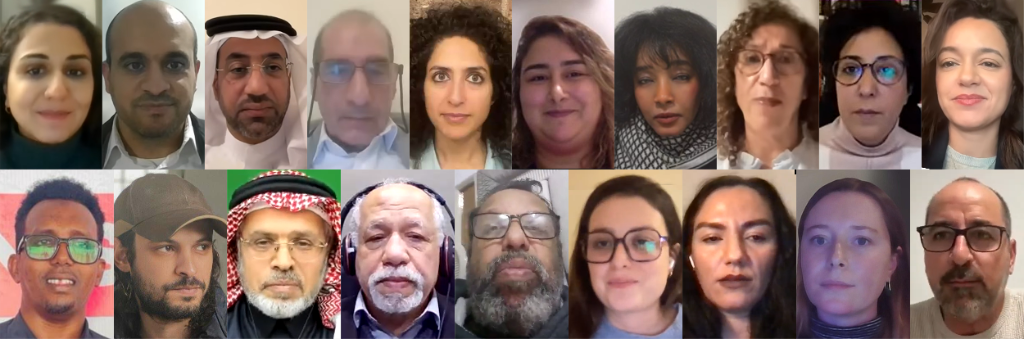
The European Saudi Organization for Human Rights (ESOHR) held its fifth annual conference for victims of Saudi violations on December 9–10, coinciding with International Human Rights Day.
Under the title “Ten Years of King Salman and His Son: What Is the State of Human Rights?”, the conference reviewed the wide range of violations committed in Saudi Arabia over the past decade, a period in which state structures and the relationship between authorities and society were reshaped. Surveillance expanded, repression deepened, and the stories of victims multiplied.
Participants discussed record numbers of executions, unprecedented and transnational repression, security dominance during the Hajj and its impact on the Gulf region, the difficulties faced by journalists, forced displacement, the crushed state of civil society, detained or travel-banned defenders, torture as a systematic practice, the consequences of the war on Yemen, exploitation of migrant workers, and Saudi Arabia’s stance on Palestinian rights.
Day One
The conference was opened and moderated by international lawyer Yasmin Omar, who previously served as an adviser to UN experts on the rule of law and conflict-related sexual violence, and later as Director of UN and Regional Mechanisms at the Committee for Justice.
ESOHR Director and co-founder Ali Adubisi delivered the opening remarks, outlining the landscape of the past decade and explaining how violations expanded and diversified since King Salman and the Crown Prince assumed power. He emphasized that victims’ cases are not isolated incidents but part of a broader framework of policies targeting civil society and human rights defenders, noting that the objective of the conference is to document this era, offer an in-depth analysis, and strengthen accountability and solidarity with victims and their families.
Saudi academic and author Dr. Madawi Al-Rasheed provided an analytical reading of the structural transformations within the Saudi system over the past ten years. She highlighted the concentration of power within a narrow circle, the expansion of surveillance over society and the public sphere, and the tightening of control over political, religious, and media domains. She discussed how political and religious institutions were reshaped into tools of domination, and how the judiciary and media were used to justify repression and manufacture superficial legitimacy, stressing that these developments cannot be described as reform but as a re-engineering of power at the expense of rights and freedoms.
Opposition activist Abbas Al-Sadiq spoke about the waves of demolition and forced displacement linked to urban-transformation projects, outlining the deep impact on communities, the shortcomings of compensation mechanisms, and how these measures have become central policies reshaping cities and regions.
Reprieve Executive Director Maya Foa reviewed capital punishment as one of the darkest areas of King Salman’s rule, noting that Saudi Arabia has executed 1,910 people since 2015 according to ESOHR data, with the true number likely higher due to secret executions. She highlighted the absence of fair-trial guarantees, the use of charges that do not meet the international threshold for the death penalty, and the patterns of intimidation reflected in the expansion of executions. She also discussed cooperation between Reprieve and ESOHR in documenting death penalty cases involving minors and prisoners of conscience.
Khalid Ibrahim, Director of the Gulf Centre for Human Rights, described the sweeping arrests of human rights defenders, long prison sentences, deaths in detention, travel bans, and the criminalization of rights work through vague laws and digital surveillance. He emphasized the dangerous environment created for independent voices in Saudi Arabia, particularly as digital surveillance tools and spyware have become part of the state’s repression apparatus.
Amnesty International campaigns officer Bissan Fakih discussed the execution of minors, explaining how Saudi Arabia portrayed itself as having reformed its juvenile system in 2018 and 2020, but continued executing minors in practice. She noted that at least fifteen minors have been executed since 2015, including two in 2025, and that others remain at risk. She described how authorities circumvent legal reforms and use them as cosmetic measures rather than genuine protections.
Activist Kholoud Al-Anzi delivered a powerful testimony from the family of a minor facing a death sentence, shedding light on the fear, silence, and inability of families to speak publicly due to security restrictions and fear of retaliation.
Saudi academic Dr. Maryam Al-Dosari examined the situation of women over the past decade. She explained how the government promoted symbolic reforms—such as allowing women to drive and modifying certain aspects of the guardianship system—as examples of “empowerment,” while deep-rooted discriminatory structures remained intact. She highlighted the targeting of women activists who demanded these rights and the gap between official rhetoric and lived reality.
Delmar Dhiyo, Secretary of the Human Rights Defenders Coalition in Somalia, discussed the situation of Somali nationals executed in Saudi Arabia, referring to them as “victims of bloodshed.” He noted that 39 Somalis were executed in 2025 alone, mostly in drug-related cases, amid lack of legal representation, language barriers, and limited communication with families or embassies. He stressed the vulnerability of African migrant workers within the Saudi judicial system.
Elaf Al-Qassab, Human Rights Officer for the Middle East and North Africa at OMCT, emphasized that torture has been a systematic feature of the past decade rather than isolated incidents. She highlighted the absence of meaningful investigations, reliance on confessions extracted through torture in capital cases, and the complete impunity enjoyed by perpetrators, noting that this environment encourages further violations.
Day Two
Political activist and journalist Dr. Saeed Al-Shehabi discussed the impact of Saudi policies on Bahrain and the region, arguing that Saudi Arabia has played a decisive role in suppressing democratic movements and maintaining political stagnation. He explained that Bahrain has become an arena for entrenching security-based governance and that Saudi Arabia uses financial influence to forestall democratic change out of fear that such developments could affect its own internal stability.
Saudi journalist and rights defender Mohammed Al-Omari addressed the management of Hajj, contrasting Saudi Arabia’s image of perfect administration with documented violations in 2023, including thousands of deaths, politically motivated arrests, and visa restrictions. He described Hajj as a “political trap” for dissidents globally and a tool for Saudi political control, arguing that the state seeks to monopolize religious discourse in the holy sites and suppress expressions of solidarity with global causes.
Journalist Jowan Saadeh spoke about press freedom in Saudi Arabia, using the killing of Jamal Khashoggi as a stark example of the state’s treatment of journalists. She explained that Saudi Arabia has no independent media, ranks poorly in international press freedom indexes, and continues to detain journalists. She described a pervasive climate of fear among sources inside and outside the country, noting that many people refused to speak due to fear of repercussions.
Egyptian journalist Basma Mostafa, Program Director at the Foundation for Law and Democracy, discussed transnational repression, including smear campaigns, the misuse of Interpol channels, and international police cooperation used to target dissidents abroad. She expressed concerns about the opening of an Interpol office in Riyadh in 2025, explaining that repression extends beyond borders and affects families through travel bans and arrests. She also noted a recent European Parliament resolution addressing transnational repression for the first time.
Saudi asylum seeker Abdulrahman Al-Khalidi, detained in Bulgaria, shared his experience with asylum rejection, prolonged detention, and the threat of deportation. He described political influence, judicial failures, and Saudi leverage in Bulgaria that placed him in danger, and noted that he has taken his case to the European Court of Human Rights.
Researcher Catriona Fraser presented findings on migrant worker abuses in Saudi Arabia’s renewable-energy sector. She documented evidence of forced labor, recruitment fees, wage deductions, and abusive conditions across multiple major projects. Workers interviewed described treatment that reduced them to “animals or machines,” illustrating the disconnect between the region’s image of clean energy and the reality of systemic labor abuses.
Syrian businessman Mohammed Al-Qadeemi shared a detailed testimony about exploitation under the kafala system, recounting extortion by a sponsor, violent raids by security forces, detention in overcrowded deportation centers, and the severe psychological harm inflicted on his children. He described additional raids and physical assault after filing complaints, the deterioration of his family’s mental health, and the long-term impact of these abuses.
Dr. Mohammed Al-Noamani discussed widespread violations against Yemenis in Saudi Arabia, including deportations, denial of Hajj access, arbitrary detentions, continued cross-border attacks despite ceasefire agreements, and Saudi-UAE involvement in secret detention facilities in Yemen. He argued that these practices reveal deep human rights violations and continued misuse of force affecting civilians.
In concluding remarks, ESOHR Director Ali Adubisi underscored that although the decade was marked by grave violations, human rights work has also grown stronger.
- He expressed solidarity with victims’ families, emphasizing that safe information-sharing sustains advocacy.
- He encouraged migrant victims to reach out to civil society organizations abroad.
- To organizationsو Saudi Arabia is investing heavily in containing the human rights situation abroad, and this is an indication that the work is having an impact. This makes it all the more important to continue developing and strengthening our efforts.
- affirmed that Saudi efforts to suppress rights work reflect its effectiveness, emphasized the crucial role of independent media.
- highlighted the growing importance of civil society in exile while calling for stronger coordination and exchange of expertise.