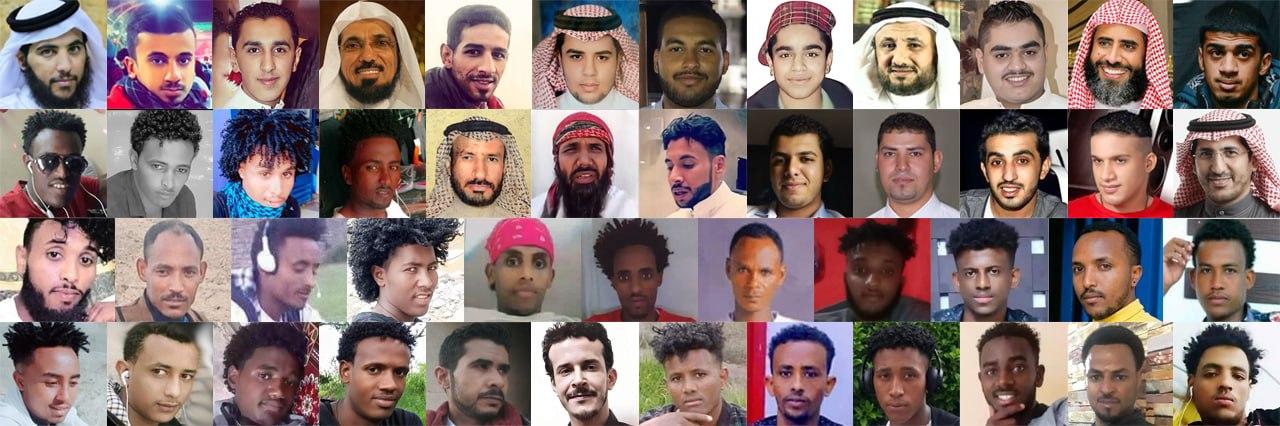
On World Day Against the Death Penalty, observed on 10 October under this year’s theme, “Stories for Life”, the European Saudi Organisation for Human Rights (ESOHR) shares the stories of individuals who remain at risk of execution in Saudi Arabia. These accounts shed light on the people behind the sentences, the violations they have endured, and the continuing suffering of their families. Although secrecy and fear of reprisals prevent the documentation of every case, these stories reveal a reality whose details are absent from the official narrative.
Saudi Arabia continues to impose and carry out death sentences amid grave human rights violations, despite official promises to reduce the use of capital punishment. Cases documented by ESOHR show that people remain at risk of execution for acts allegedly committed as children or for exercising legitimate rights. Foreign nationals also face execution following trials that lack fair trial guarantees. Behind these sentences are families living through years of fear and uncertainty, compounded by the prospect of being denied a final farewell, the return of their loved ones’ bodies, and information about their burial sites.
I. The Death Penalty in Political Cases
Saudi Arabia executes people facing political charges, including charges related to freedom of expression and the exercise of legitimate rights, such as protest and peaceful assembly. According to ESOHR’s monitoring, at least 54 people face death sentences handed down by the Specialized Criminal Court in cases involving various political charges. Secrecy and difficulties accessing court files have prevented ESOHR from documenting all these cases in detail. However, the organisation has followed several of them, uncovering grave violations and lasting consequences for detainees and their families.
At Risk of Execution for Acts Allegedly Committed as Children
The Juvenile Law, enacted in 2018, defines a juvenile as a person who has reached the age of seven but is under eighteen. Protection against execution for childhood offences hinges on the person’s age at the time of the alleged act.
Since King Salman bin Abdulaziz assumed power in 2015, and as Crown Prince Mohammed bin Salman’s authority has grown, Saudi Arabia has executed at least 17 people for acts allegedly committed when they were children. Thirteen of these executions took place after the Juvenile Law was enacted.
ESOHR is currently following the cases of at least five people at risk of execution for acts allegedly committed as children: Ali Jaafar al-Mubayouq, Youssef Mohammed al-Manasif, Jawad Abdullah Qureiris, Hassan Zaki al-Faraj, and Mahdi al-Mohsen.
The charges against them include participating in protests and funeral processions, filming demonstrations, chanting slogans, and other political activities, alongside additional allegations that vary from case to case. In Youssef al-Manasif’s case, some of the alleged acts date back to when he was fifteen and sixteen, including attending the funerals of people shot dead by security forces. His case also includes allegations of participating in demonstrations, chanting slogans, and displaying slogans opposing the state.
Ali Jaafar al-Mubayouq told the judge that the demonstrations in which he was accused of participating took place when he was a child, and that his confessions had been extracted under torture. In the cases of Jawad Qureiris and Hassan Zaki al-Faraj, a review of the dates of the alleged acts indicates that some charges concern conduct before they turned eighteen. Their case files include charges related to following pages or joining groups on social media.
ESOHR has also documented grave violations in these cases, including incommunicado detention, denial of regular contact with families, severe torture and ill-treatment to extract confessions, and denial of access to a lawyer during critical stages of the investigation.
Religious Figures and Intellectuals
Sheikh Salman al-Awdah
Sheikh Salman al-Awdah was arrested in September 2017 after posting a tweet calling for reconciliation amid the Gulf crisis between Saudi Arabia and Qatar. His family was banned from travelling, and family members, including children, were subjected to arbitrary searches.
He was denied contact with his family for periods of time, placed in solitary confinement, and suffered deteriorating health in detention. Before the Specialized Criminal Court, the Public Prosecution sought his execution as a discretionary punishment (ta’zir) in connection with his public activities, positions, and communications. His trial remains unresolved.
Sheikh Awad al-Qarni
Sheikh Awad al-Qarni was arrested during the September 2017 crackdown. The Public Prosecution sought the death penalty on charges related to his speeches, writings, public profile, and use of social media.
Hassan Farhan al-Maliki
Hassan Farhan al-Maliki is a researcher and thinker known for his critical views and writings on history and religious thought. He was arrested in September 2017. The Public Prosecution sought his execution as a discretionary punishment in a trial linked to his views and peaceful exercise of freedom of expression.
Ali Hamza al-Omari
Ali Hamza al-Omari is a religious preacher and media figure arrested during the same crackdown. The Public Prosecution sought his execution in a case involving charges related to his media and charitable activities and expression of his views. Many details of his trial have remained beyond independent scrutiny, while the threat of execution and the resulting suffering for him and his family persist.
Protesters Facing the Death Penalty
In recent years, Saudi Arabia has executed dozens of young men on charges related to protests, demonstrations, and other events in the country, particularly in the Eastern Province during and after the Arab Spring. Despite limited information and secretive trials, ESOHR has confirmed that several young men remain at risk of execution on political charges, including protest-related charges. Among them are Mohammed Hassan al-Labbad and Mohammed Abdullah al-Faraj.
The charges against them concern participation in protests, gatherings, and funeral processions, as well as criticism of state policies. Information gathered by ESOHR indicates that both were subjected to incommunicado detention, solitary confinement, torture, and ill-treatment to extract confessions, and were denied effective access to a lawyer during the investigation.
In Opinion No. 60/2025, the Working Group on Arbitrary Detention concluded that the detention of Mohammed Abdullah al-Faraj and Mohammed Hassan al-Labbad was arbitrary, citing violations relating to personal liberty, fair trial rights, freedom of expression, and freedom of assembly.
Mohammed Hassan al-Labbad is the brother of Jalal al-Labbad, whom Saudi Arabia executed in August 2025 for alleged acts dating back to his childhood, and Fadel al-Labbad, who was executed in April 2019. The family’s experience illustrates the cumulative impact of raids, arrests, and executions: it has lost two sons to execution, while other family members remain behind bars.
ESOHR is also following the cases of six people sentenced to death as a discretionary punishment in November 2022, whose sentences were subsequently upheld on appeal: Zuhair al-Samkhan, Ridha al-Shayeb, Mohammed al-Tahnoun, Mustafa Abu Shaheen, Mohammed Abdulrazzaq al-Misbah, and Abdullah Ghazwi.
The charges include Ridha al-Shayeb and Mohammed al-Tahnoun’s use of messaging applications to contact individuals, and Mustafa Abu Shaheen’s use of email, WhatsApp, and Telegram to communicate with wanted persons, as well as possession of images that the prosecution characterised as support for terrorism.
The Howeitat: Death Sentences in the Context of NEOM
The cases of Shadhli Ahmed Mahmoud al-Howeiti, Attaallah al-Howeiti, and Ibrahim al-Howeiti are linked to violations in the Tabuk region in the context of evictions associated with the NEOM project.
The Specialized Criminal Court sentenced the three men to death in October 2022. The Specialized Criminal Court of Appeal upheld their sentences in January 2023.
Shadhli al-Howeiti is the brother of Abdulrahim al-Howeiti, who was killed by security forces in April 2020 after refusing to leave his home in the village of al-Khuraybah for the NEOM project. Shadhli worked as director of agriculture in al-Bad’ governorate before being transferred to the agriculture department in Duba governorate. He was arrested at his farm in November 2020, along with another brother and his brother-in-law, and was then subjected to enforced disappearance for two months.
The charges against him included “establishing a terrorist organisation to rebel against the ruler” and “creating a Twitter account to undermine national cohesion”. According to published information, he was subjected during the investigation to electric shocks, beatings on the soles of his feet, exposure to extreme temperatures, sleep deprivation, and prolonged solitary confinement. He also went on hunger strikes to protest torture and ill-treatment and was subjected to force-feeding.
II. Foreign Nationals and the Death Penalty
Foreign nationals and stateless people accounted for 56.2% of all those executed by Saudi Arabia in 2025. Of the 356 people executed that year, 200 were foreign nationals or stateless, compared with 156 Saudi nationals. The proportion was even higher in drug-related cases: of the 240 people executed for drug offences in 2025, 188 were foreign nationals, approximately 78.3%.
Those executed came from numerous countries, including 39 Somalis, 35 Pakistanis, 35 Ethiopians, 25 Egyptians, 18 Afghans, 11 Jordanians, nine Nigerians, seven Syrians, six Iranians, six Yemenis, and five Sudanese, as well as nationals of India, Nepal, and Bangladesh and one stateless person.
These figures demonstrate the extent to which foreign nationals are exposed to the death penalty in Saudi Arabia, particularly for drug offences, which do not meet the threshold of the “most serious crimes” under international law.
Saudi authorities do not publish the number of foreign nationals sentenced to death, their names, places of detention, or the procedural status of their cases. Despite this lack of information, ESOHR has documented several cases revealing the barriers and violations foreign nationals face during arrest, trial, and the wait for execution.
Egyptians: Executions Despite Promises to Restrict the Death Penalty
ESOHR had monitored the cases of at least 33 Egyptian nationals facing death sentences in Saudi Arabia, mostly for drug offences. During the latest wave of executions, most of those whose cases the organisation had been following were executed. Available information confirms that at least three Egyptians remain at risk of execution.
Detainees and their families reported grave violations, including lack of access to lawyers, torture and ill-treatment, being forced to sign documents or confessions, inability to understand judicial proceedings, and difficulties obtaining copies of judgments and case files. Some spent years in Tabuk Prison awaiting execution, while their families held on to official statements that had led them to believe the sentences might not be carried out.
In 2018, Crown Prince Mohammed bin Salman announced that Saudi Arabia was working to reduce the use of the death penalty and limit it to a narrow range of cases. The Saudi Human Rights Commission also spoke of reforms and restrictions on its application. Yet these promises did not prevent the resumption of executions for drug offences from late 2022 onwards, nor did they protect Egyptians awaiting a review of their sentences.
In 2025, Saudi Arabia executed Farhat Abu al-Soud and Mohammed Kamel Salah Kamel without notifying their families in advance or returning their bodies. In December of the same year, Essam al-Shazly was executed in Tabuk Prison while his family was awaiting a decision on a petition submitted to the Supreme Court. According to available information, the petition was rejected just one day before his execution.
Ethiopians: From War and Poverty to Death Row
In 2025, Saudi Arabia executed 35 Ethiopian nationals in drug-related cases. Executions continued in 2026: ESOHR documented the execution of at least 20 Ethiopians by the end of August, followed by further executions in September. There is no official figure for the number of Ethiopians sentenced to death. Some reports have suggested that more than 200 are at risk, but ESOHR has been unable to independently verify that figure.
Information gathered by the organisation indicates that dozens of Ethiopians are held in Khamis Mushait Prison alone. One list contained 65 names in a death row ward, alongside other detainees in different wards. Executions carried out in the Najran region also confirm that Ethiopians under sentence of death are held in other prisons and regions.
Many of these men left their home areas because of war, poverty, and a lack of employment opportunities. Some were displaced by the war in Tigray, and some had their homes or livelihoods destroyed. They took migration routes through Djibouti or Yemen in search of safety, work, and medical treatment.
During their journeys, some were deceived or exploited. Some received promises of work; others were asked to carry bags or goods whose contents they did not know, or were told that they contained khat or ordinary items. According to information gathered by ESOHR, their testimonies suggest possible indicators of human trafficking or exploitation in criminal activities that were not seriously examined during their trials.
Some reported being shot and wounded, while others described beatings and torture during arrest and detention. Detainees were also forced to sign records written in Arabic that they did not understand and were denied access to lawyers and effective interpretation. Some said that no interpreter was present during questioning, or that the interpreter’s role in court was limited to informing them that they had been sentenced to death. Prisoners said that some fellow detainees who were executed had appointed lawyers and signed applications for appeal or case review, but were executed before their challenges received an effective hearing.
III. Lack of Notification and Withholding of Bodies
People sentenced to death and their families endure continuing suffering, intensified by the fear that executions will take place without prior notification or an opportunity to say goodbye. In previous cases, ESOHR has documented failures to notify families and the denial of a final phone call to those facing execution. As a result, every interruption in communication becomes a source of anxiety for families whose loved ones remain at risk.
These families fear learning of an execution through the media, other prisoners, or members of their community—as has happened in cases documented by ESOHR—rather than receiving official notification from Saudi authorities or their home country’s embassy.
The continued withholding of the bodies of executed people, and the failure to disclose their burial sites, also weigh heavily on families of those currently sentenced to death. They fear not only losing their loved ones, but also being denied the return of their bodies, the opportunity to bury them according to their beliefs, and the ability to visit their graves. This suffering persists throughout the wait and may continue after execution.
Conclusion
On the World Day Against the Death Penalty, under the theme “Stories for Life,” the European Saudi Organisation for Human Rights considers that the stories behind executions reveal the gravity of human rights violations in Saudi Arabia and contradict official promises of reform. They expose a reality that the government’s narrative seeks to conceal and justify. The impact of these violations extends to families who endure years of fear and uncertainty and may be denied a final farewell, the return of their loved ones’ bodies, and knowledge of where they are buried.
Amid secrecy and fear of reprisals, documenting these stories remains a means of exposing the gap between the image of reform Saudi Arabia seeks to present and the experiences of those who continue to face execution in its prisons.